
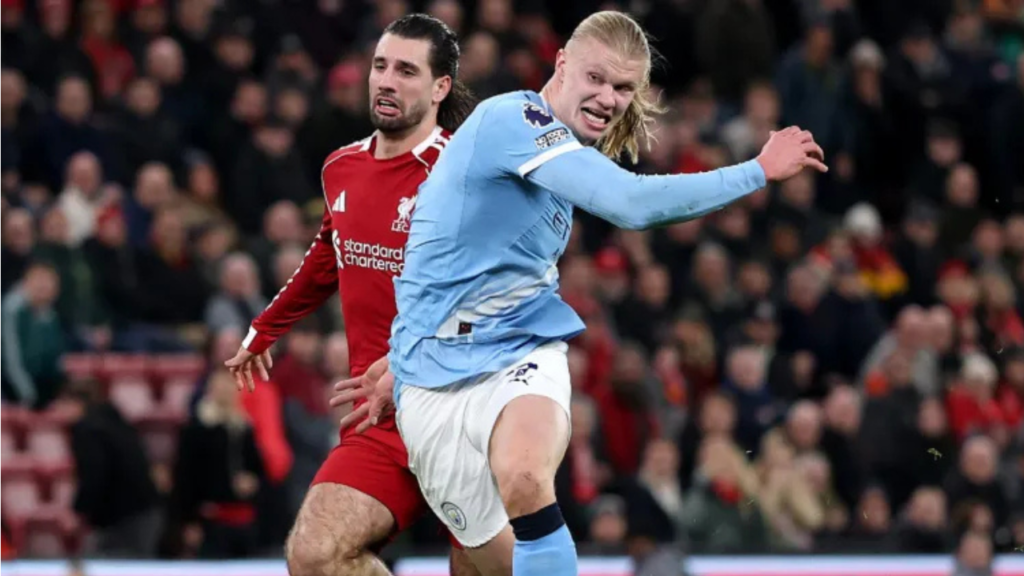
It was a finale that defied belief, even by the high standards of the Premier League‘s most intense rivalry. In the space of ten chaotic minutes, Liverpool‘s Dominik Szoboszlai experienced the full spectrum of footballing emotions. One moment he was the toast of the Kop, having scored a world-class free-kick; the next, he was trudging off the pitch with a straight red card. The dismissal, which came deep into stoppage time of the 2-1 defeat to Manchester City, left fans baffled and pundits debating the nuances of the laws of the game.
The Chaos at the Death
With the clock ticking past the 100th minute and Liverpool trailing 2-1, manager Arne Slot threw caution to the wind. Goalkeeper Alisson Becker ventured forward for a last-gasp corner, leaving his net completely unguarded. The move backfired spectacularly. Manchester City cleared the danger, and Erling Haaland was suddenly away in space, sprinting towards an empty goal from the halfway line.
Szoboszlai, sensing the imminent disaster, scrambled back. In his desperation, he grabbed a handful of Haaland’s shirt, hauling the Norwegian to a halt. Haaland, not one to shy away from a battle, retaliated by tugging Szoboszlai back. Amidst the grappling, City’s Rayan Cherki spotted the vacated goal and dispatched the ball into the empty net from distance.
Why the Goal Didn’t Stand and the Card Did
Anfield held its breath as the referee, Craig Pawson, paused for a lengthy VAR review. The expectation was that either the goal would stand or a free-kick would be awarded to Liverpool for Haaland’s retaliation. Instead, the outcome stunned the home crowd.
The video assistant referee identified that Szoboszlai’s shirt pull occurred before Haaland’s retaliation. Under IFAB laws, the initial foul takes precedence. Because Szoboszlai denied Haaland a clear, unimpeded path to an empty goal, it was classified as a “Denial of an Obvious Goal-Scoring Opportunity” (DOGSO).
Since the foul occurred outside the penalty area, the mandatory punishment is a straight red card. The subsequent foul by Haaland was deemed to have nullified any advantage Manchester City might have gained from the counter-attack, leading to Cherki’s goal being disallowed. The final decision: a free-kick to City and Szoboszlai sent for an early bath.
Understanding the DOGSO Rule
The red card has sparked debate, but the application of the law was strict and textbook. For a DOGSO offense to warrant a dismissal, four criteria must be met:
- Distance: The offense was close enough to the goal to have a high chance of scoring (Haaland was effectively through).
- Direction: Play was moving directly towards the open goal.
- Likelihood of Control: Haaland had full control of the ball.
- Defenders: There were no defenders between Haaland and the goal line, primarily due to Alisson’s position.
Szoboszlai’s unfortunate foul checked every box. It was a split-second decision made in desperation, but technically, it denied a certain goal. The result is a one-match suspension for the Hungarian midfielder, a bitter pill to swallow after a performance where he had been the standout player.
For more match previews and team news, visit this page for English Premier League updates.